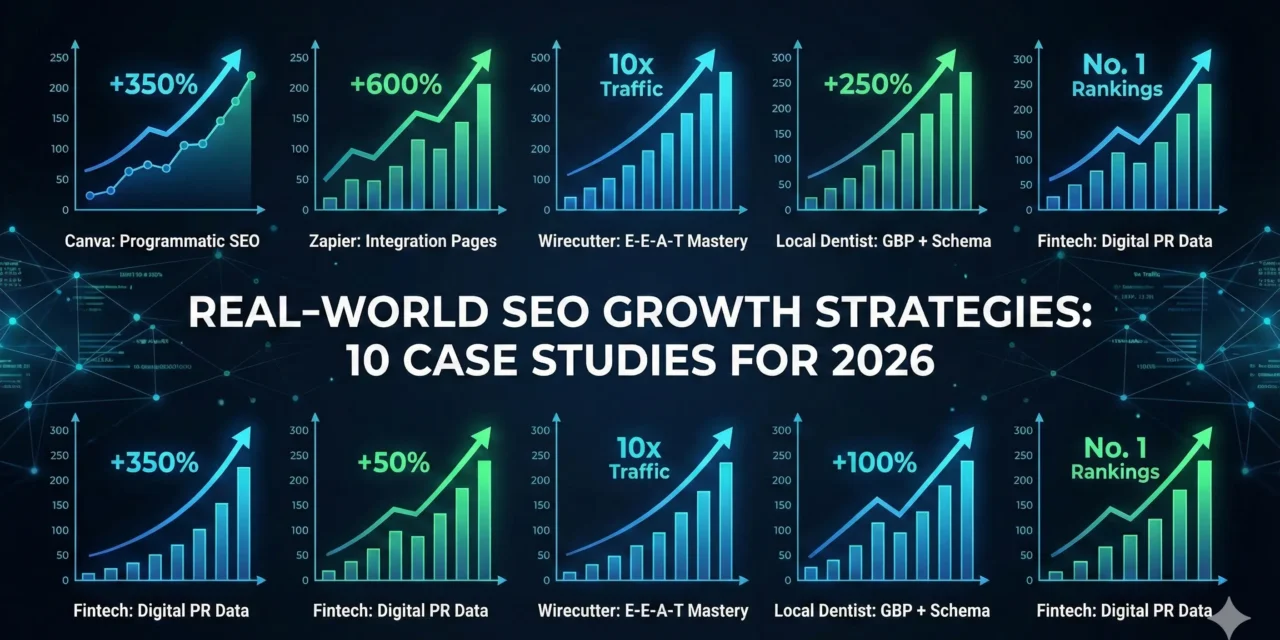
Most marketers read high-level summaries, but true experts look for the details. If you are tired of fluff and want to see the granular mechanics of growth, this guide to SEO case studies is for you.
We have deconstructed 10 of the most successful search campaigns in history. We aren’t just telling you what they did; we are showing you how they did it, step-by-step. From programmatic architecture to complex technical cleanup, these SEO case studies serve as a blueprint for your own strategy.
If you need a team to implement these advanced tactics for you, explore our technical SEO services.
10 In-Depth SEO Case Studies: The Blueprint for Growth
Below, we analyze the specific methodologies used in these SEO case studies to turn stagnant websites into traffic engines.
1. The Programmatic Scale: Canva
The Challenge: Canva needed to rank for millions of design intent keywords (e.g., “wedding invitation,” “blue resume,” “cat poster”) without hiring 10,000 writers.
The Execution Details:
- Pattern Identification: They identified a keyword pattern:
[Design Type] + Templateand[Adjective] + [Design Type]. - Page Generation: They built a “programmatic SEO” engine. Instead of writing unique text for every page, they created a high-quality “Master Template.” The code dynamically pulls in the relevant design thumbnails for that specific keyword.
- Internal Linking: They created a “Related Designs” section on every page to cross-link these thousands of landing pages, creating a massive spiderweb of relevance.
The Result: Canva now dominates the SERPs for almost any design-related query, proving that automation—when done with quality—wins.
2. The Technical Cleanup: Mid-Sized E-Commerce
The Challenge: An apparel store had 500,000 pages indexed but only 5,000 products. This is known as “Index Bloat,” and it destroys rankings because Googlebot runs out of crawl budget.
The Execution Details:
- Audit: The team used Screaming Frog to discover that every time a user clicked “Sort by Price” or “Filter by Blue,” a new URL was generated and indexed.
- The Fix (Robots.txt): They updated their robots.txt file to specific disallow parameterized URLs:
Disallow: /*?sort=andDisallow: /*?filter=. - The Fix (Canonical Tags): They set a “Self-Referencing Canonical” on the main category page, telling Google: “Ignore the filtered versions; count the main page as the only original.”
The Result: Organic traffic jumped 140% in 90 days simply by helping Google focus on the right pages.
3. The Bottom-of-Funnel King: Zapier
The Challenge: Capturing users who already know what they want and are ready to convert.
The Execution Details:
- The “Integration” Strategy: Zapier created three tiers of pages:
- App landing pages (e.g., “Google Sheets Integrations”).
- App-to-App pages (e.g., “Connect Google Sheets to Trello”).
- Workflow pages (e.g., “Add new Trello cards to Google Sheets rows”).
- Dynamic H1s and Meta: They used dynamic insertion to ensure every page had perfect on-page SEO (e.g., Title: “Connect [App A] + [App B] in 2 minutes”).
The Result: This is one of the most famous B2B SEO case studies because it built a multi-billion dollar valuation entirely on search traffic.
4. The Authority Play: The Wirecutter
The Challenge: Ranking for “Best [Product]” keywords against thousands of spammy affiliate sites.
The Execution Details:
- Extreme Content Depth: While competitors wrote 500 words, Wirecutter wrote 5,000 words. They included a “How We Tested” section detailing the hours spent and methodology used.
- Transparent Authorship: Every author had a detailed bio linking to their LinkedIn and past work, satisfying Google’s E-E-A-T (Experience, Expertise, Authoritativeness, Trust) guidelines.
- No Clickbait: They put the answer (the winner) at the very top of the page to satisfy user intent immediately.
The Result: High user trust led to high dwell time, signaling to Google that their content was superior.
5. The Local Standardization: Dental Franchise
The Challenge: A 50-location franchise had messy data. Some listings said “Dr. Smith,” others said “Smith Dental.”
The Execution Details:
- NAP Cleanup: They ensured Name, Address, and Phone number (NAP) were identical across Google, Bing, Yelp, and Apple Maps.
- Location Pages: They built a unique page for each clinic on their website (e.g.,
/locations/new-york). Critically, they embedded the Google Map and added “Local Business Schema” JSON-LD code to each page. - Review Velocity: They implemented an SMS campaign asking patients for reviews immediately after appointments.
The Result: A 350% increase in phone calls generated directly from Google Maps.
6. The Digital PR “Linkbait”: Fintech Startup
The Challenge: Building Domain Authority (DA) without buying shady links.
The Execution Details:
- The Hook: Journalists love data. The startup scraped public financial data to uncover a trend: “Millennials are saving 20% less than Gen X.”
- The Asset: They visualized this data into high-resolution infographics and hosted it on a branded blog post.
- The Outreach: They did not ask for a link. They emailed journalists saying: “We found this data, here is the chart, feel free to use it in your story.”
The Result: High-authority news sites (DA 90+) used the chart and cited the source, boosting the startup’s SEO power significantly.
7. The Intent Pivot: B2B Agency
The Challenge: High traffic, low sales. They ranked for “What is marketing?” but those searchers weren’t buyers.
The Execution Details:
- Keyword Audit: They stopped tracking “Vanity Keywords” (high volume) and started tracking “Money Keywords” (high intent).
- Content Rewrite: They wrote comparison articles (e.g., “Agency vs In-House”) and “Alternatives” posts (e.g., “Best HubSpot Alternatives”).
- CTA Optimization: They changed their Call-to-Action from “Subscribe to Newsletter” to “Book a Strategy Call.”
The Result: Total traffic dropped, but revenue tripled. This is one of the most vital lessons in our SEO case studies collection.
8. The YMYL Recovery: Health Publisher
The Challenge: A “Core Update” crushed their rankings because they gave medical advice without credentials.
The Execution Details:
- The Purge: They deleted 30% of their content that was too short or unverified.
- The Expert Layer: They hired doctors to review the remaining articles. They added a “Medically Reviewed on [Date] by [Doctor Name]” stamp at the top of every post.
- Citations: They added external links to PubMed and academic journals to back up every health claim.
The Result: The site recovered fully, proving that trust is the most important ranking factor for health sites.
9. The Topic Cluster: HR Software
The Challenge: Google viewed them as a general blog, not an expert.
The Execution Details:
- The Hub Page: They created a 4,000-word “Ultimate Guide to Employee Onboarding.”
- The Spoke Pages: They wrote 20 smaller articles on specific questions like “onboarding checklist for developers” and “remote onboarding tips.”
- The Link Structure: Every spoke page linked back to the Hub, and the Hub linked out to every spoke. This passed “link juice” around the cluster.
The Result: They achieved “Topical Authority,” ranking #1 for the main keyword and dominating the niche.
10. The International Hreflang: Tech Vendor
The Challenge: US content was showing up in Germany, but German users bounced because it was in English.
The Execution Details:
- Localization: They translated key pages into German and Japanese using native speakers.
- Technical Implementation: They added
<link rel="alternate" hreflang="de" href="example.com/de/" />to the header. This code tells Google: “If the user is in Germany, show them THIS URL, not the US one.”
The Result: Immediate decrease in bounce rate and a massive spike in international conversions.
Conclusion: Applying These Strategies
These 10 SEO case studies prove that there is no magic button. Success comes from detailed execution—whether that is cleaning up your code, structuring your content into clusters, or automating your page creation.
Do you need help applying these advanced strategies to your business? Contact us today for a comprehensive audit.