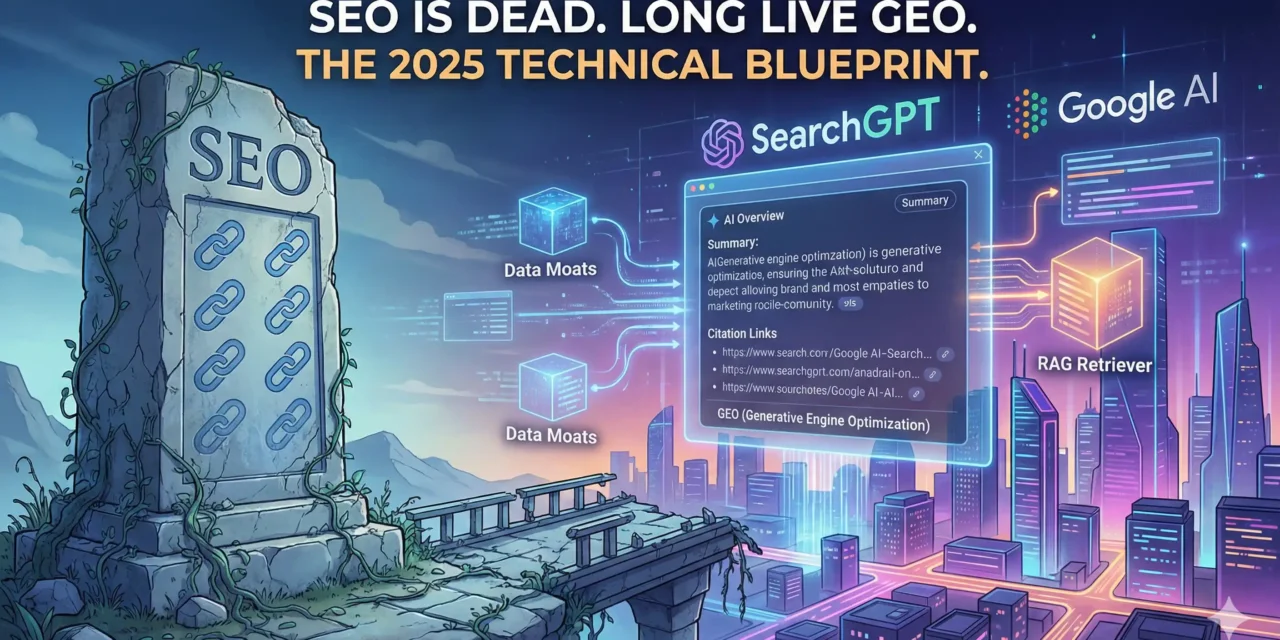
SEO is Dead. Long Live GEO: The Technical Blueprint for 2025
The “10 blue links” era is officially over. With Google’s AI Overviews becoming the standard and the rise of SearchGPT, ranking #1 is no longer the ultimate goal. The new goal is to be cited.
Most SEO advice right now is telling you to “write helpful content.” That is vague and dangerous advice. If you just write “helpful” summaries, Large Language Models (LLMs) will ingest your content, summarize it for the user, and give you zero clicks.
To survive in 2025, you need to shift from traditional optimization to GEO (Generative Engine Optimization) and prepare for the era of Agentic SEO.
Here is the technical strategy that top results aren’t telling you—focusing on Data Moats and Vector Space Optimization.
1. The “Data Moat” Strategy: Make Yourself Un-Summarizable
AI models are excellent at summarizing general knowledge. If your blog post is “What is SEO?”, ChatGPT can answer that better than you. You cannot compete on general knowledge anymore.
The Fix: You must publish Proprietary Data. LLMs hallucinate facts. To avoid this, they prioritize sources that provide hard, structured data (numbers, statistics, original case studies).
- Don’t write: “AI is changing marketing.”
- Do write: “We analyzed 10 SEO growth case studies and found that AI Overviews reduced organic CTR by 14% in the SaaS sector.”
Why this works: The AI needs your specific data point to ground its answer. It cannot generate this number on its own. It must cite you.
2. Optimize for “RAG” (Retrieval-Augmented Generation)
Search engines now use RAG (Retrieval-Augmented Generation) to fetch snippets of info to feed the AI. Your content needs to be formatted not just for humans, but for the “Retriever.” This is critical whether you are doing SEO or looking at PPC trends for 2026.
- The “Passage Indexing” Hack: LLMs read in chunks. Structure your content so that every 150-200 words is a self-contained logical unit.
- Key-Value Pair Formatting: Don’t bury answers in long paragraphs. Use direct formatting that looks like a database entry.
- Bad: “The price depends on many factors but usually starts around…”
- Good: Average Cost: $500 – $1,000 per month.
3. Own the “Entity Co-occurrence”
Keywords are for search engines; Entities are for AI. Google’s Gemini and OpenAI map the relationship between “Entities” (Brand, Person, Concept). You need to force an association between your Brand and your Niche Topic.
Actionable Step: Ensure your brand name appears in the same sentence or paragraph as your target topic. You don’t just need a backlink; you need semantic proximity. Using the top SEO automation software can help track these entity mentions at scale.
4. Technical Schema for the AI Era
Standard Schema is table stakes. For GEO, you need to double down on Dataset schema.
- Dataset Schema: If you use the “Data Moat” strategy mentioned in step 1, wrap that table in Dataset Schema. This signals to Google: “Here is raw data you can use for computation.”
Conclusion: Do Not Feed the Beast Without a Return
If your content can be easily summarized, you will lose traffic. The future belongs to content creators who build information that is so unique that the AI has no choice but to send the user to you.
Stop optimizing for keywords. Start optimizing for citations. If you need help navigating this transition, consider working with expert SEO optimization consultants or hiring professional SEO services to build your strategy.